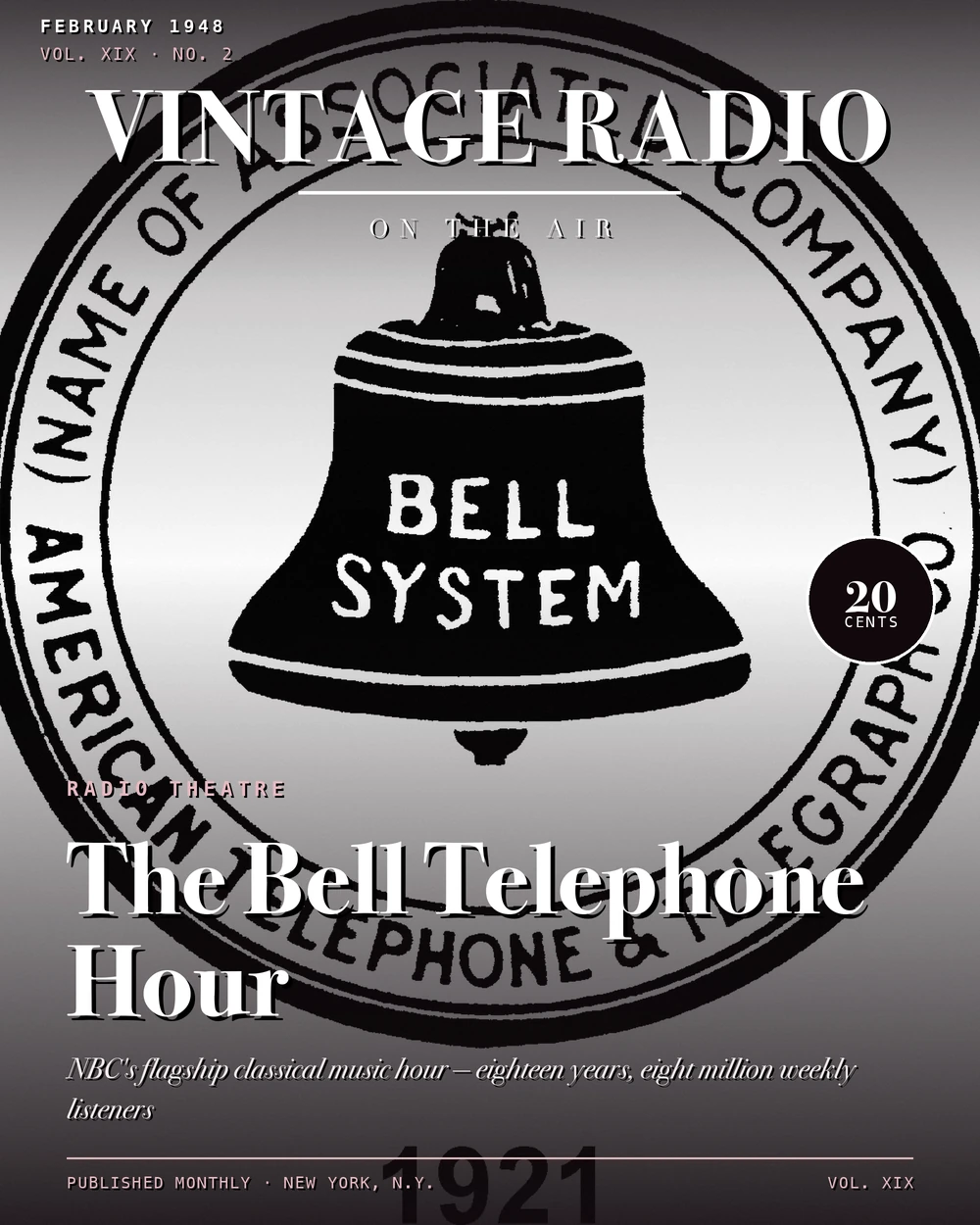
The Bell Telephone Hour
How It Got Started
Few radio programs could claim, from their very first broadcast, a theme song written specifically for them by the man who would lead the orchestra for the next eighteen years. Donald Voorhees composed the Bell Waltz for the show's premiere on April 29, 1940, and then stood at the podium for the entire run — a continuity that gave the program an unusual sense of institutional identity. Voorhees wasn't just a hired conductor cycling through seasons; he was the musical spine of the thing, shaping its sound and selecting its repertoire alongside producer Wallace Magill from start to finish.
The show went out on NBC every Monday at 8 PM, later shifting to 9 PM, with a 57-piece symphony orchestra assembled largely from players in the New York Philharmonic. That's not a detail to skim past — pulling together that many Philharmonic musicians for a weekly commercial broadcast was a genuine commitment from Bell Telephone, the sponsor throughout the entire eighteen-year run. The earliest format paired tenor James Melton and soprano Francia White as featured soloists, supported by a chorus led by Ken Christie and a sound that Tune In magazine described as "a musical melting pot, blending the old world with the new, from Bach to Irving Berlin, from Swanee River to Santa Lucia, from Latin American folksongs to the latest in Russian opera." That wide range was part of the original design — accessible enough for a general audience, substantive enough for serious listeners.
Voorhees came to the assignment already steeped in this kind of work. He had been a musical prodigy in Allentown, Pennsylvania — reportedly conducting at a church at eleven and leading the Lyric Theatre orchestra by fifteen — and by seventeen he was conducting on Broadway. In 1930 he was in the pit for Gershwin's Girl Crazy, with a band that included Glenn Miller, Tommy and Jimmy Dorsey, Artie Shaw, Red Nichols, and Gene Krupa. Before Bell, he had been music director of the General Motors Hour, where he built the relationships with leading classical musicians that would later fill the Telephone Hour's guest book.
The Great Artists Series
The format that would define the program for most of its life took shape on April 27, 1942, when violinist Jascha Heifetz became the first guest star of what Magill called the "Great Artists Series." Instead of rotating through a small roster of resident soloists, the show would now bring in the biggest names from the opera stage and the concert hall, week after week, year after year. Heifetz alone made 37 return appearances by 1949, and his interpretation of Dinicu's Hora Staccato became the single most requested number in the show's history.
The roster of artists who came through over the following sixteen years reads like a catalog of mid-century classical performance. Marian Anderson, Helen Traubel, Lily Pons, Grace Moore, John Charles Thomas, Blanche Thebom, Gladys Swarthout, Bidu Sayao, Jennie Tourel, Jussi Bjoerling, Gregor Piatigorsky, pianist Jose Iturbi, and soprano Maggie Teyte all appeared. Nelson Eddy and Oscar Levant turned up too, bridging the gap between the concert world and popular entertainment. Pianists Robert Casadesus and Josef Hofmann were frequent guests as well, alongside soprano Eileen Farrell. Perhaps the most telling measure of the show's prestige: violinist Fritz Kreisler, who had long refused to do radio, finally relented and appeared on The Telephone Hour — then came back seventeen more times over eight years.
How It Was Made
The production wasn't casual. Guests were booked as much as a year in advance, and programs were worked out in detail two months before broadcast. Magill selected the music himself, though the caliber of the artists involved meant there was always substantial discussion about what would actually get played. A show built around performers of this stature required genuine negotiation, not just scheduling. The broadcasts originated from NBC's New York facilities, primarily Studio 6A and the Cathedral Studio at 711 Fifth Avenue, and a glimpse of how the work actually came together survives in an unusual artifact: a 1947 theatrical short called Rehearsal: The Telephone Hour, produced by Leslie Roush Productions for the Bell System and shot in NBC's Studio 6B at 30 Rockefeller Plaza. The 27-minute film followed Ezio Pinza and Blanche Thebom preparing the duet "Là ci darem la mano" from Don Giovanni with Voorhees conducting, and announcer Tom Shirley appearing on camera.
That discipline showed up in the numbers. The audience held steady at an estimated eight to nine million listeners each week, and it never wavered throughout the run. That kind of consistency, across nearly two decades on the air, is hard to attribute to luck. It suggests a program that knew exactly what it was doing and kept doing it. By 1950, NBC had positioned the show inside a block it called "NBC's Monday Night of Music," linked with The Railroad Hour, The Voice of Firestone, and the NBC Symphony.
A few times each year, Magill made room for popular fare — Bing Crosby, Benny Goodman, and at least one memorable pairing of Ezio Pinza and Mary Martin performing melodies from South Pacific. These weren't departures from the show's identity so much as deliberate releases of pressure, reminders that the program was still connected to what people were actually listening to outside the concert hall. On December 14, 1953, Fred Allen read the narration for Prokofiev's Peter and the Wolf while Voorhees conducted — the same program had been offered earlier with Basil Rathbone in the narrator's chair.
Despite the title, only two of the 935 episodes ever ran a full hour. The first came in 1947, marking the centennial of Alexander Graham Bell's birth, with Helen Traubel and Raymond Massey.
What It Did for Young Performers
Starting in 1946, The Bell Telephone Hour added an annual feature that set it apart from most prestige music programs of the era: a showcase for the winners of the Walter W. Naumburg Musical Foundation awards. These were young, unknown performers — not established stars — and the show gave them a national audience at a moment when a single broadcast could genuinely alter the arc of a career. It was a practical investment in the future of classical performance, built into the schedule as a regular commitment rather than an occasional gesture.
The show's relationship with emerging talent went further than the Naumburg slot. Pianist Lorin Hollander made his Telephone Hour debut in 1956 at age twelve, and years later he would recall the program as "a way in which all of America could share an enriching experience." Many of the artists who became recognizable names to the general public did so through repeated exposure on The Bell Telephone Hour specifically. The platform was that significant, and Magill understood the cumulative effect of bringing the same artists back season after season.
Recognition and the Final Years
The Bell Telephone Hour won a Peabody Award in 1944 in the Entertainment-Music category — radio's highest recognition. By the mid-1950s, the show had moved its broadcasts to Carnegie Hall, a shift that formalized what the program had been in practice for years — a concert series that happened to be on the radio, rather than a radio show that happened to feature classical music.
The radio program ended on June 30, 1958, with Theodor Uppman singing a Massenet aria as the final selection of the 935th broadcast. Eighteen years, one conductor, one sponsor, and a weekly audience most shows never approached at their peak.
The story didn't quite end there. On January 12, 1959, The Bell Telephone Hour returned on NBC television, becoming one of the first programs the network telecast exclusively in color using RCA's system, and one of the earliest to be preserved on color videotape. The television run lasted nearly a decade, presenting an extraordinary range of artists — Renata Tebaldi, Leontyne Price, Joan Sutherland, Birgit Nilsson, Richard Tucker, Robert Merrill, and Anna Moffo from the opera world, alongside Julie Andrews, Ella Fitzgerald, Duke Ellington, Harry Belafonte, Mahalia Jackson, and dancers from George Balanchine's New York City Ballet. The TV series picked up two more Peabody recognitions of its own, including a 1959 award whose citation quoted Jack Gould of the New York Times calling the series "a varied delight with impeccable taste."
Voorhees himself wasn't quite finished with the material either. In September 1968, a full decade after the radio show left the air, he returned to NBC to host and narrate Encores from the Bell Telephone Hour, a Sunday series of highlights drawn from the old broadcasts, paired with interviews with the original performers. That series ran through June 1969. The fact that the archive could sustain an entire follow-up program speaks to how much the original show had accumulated over its run — eighteen years of recordings from some of the most significant classical performers of the mid-twentieth century, most of them at the height of their powers. The New York Public Library for the Performing Arts now holds that archive, weekly broadcasts from 1940 through 1958 alongside rehearsals, interviews, and commercials, all gathered into the Bell Telephone Hour Collection of Sound Recordings.